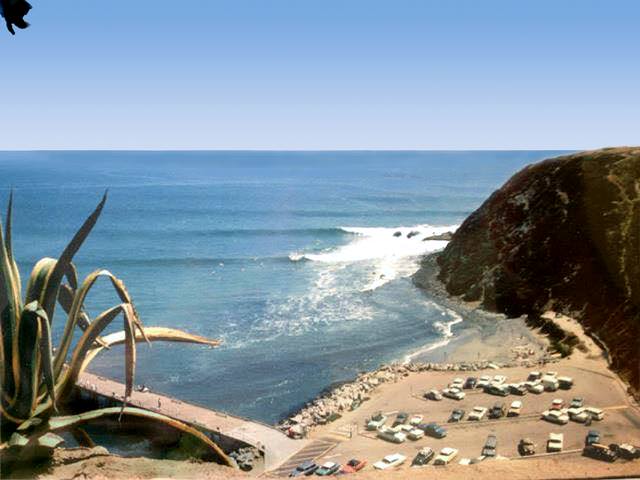
Long before there was a jetty or a harbor, there was a placed called Dana Cove. It had a long right-pealing wave, reefs full of lobster and abalone, and was loved by both fishermen and surfers alike. I was lucky enough to surf it, and lucky enough to be asked to write about it by Samanatha Dunn, Senior Editor, for the South Coast Media Newsgroup.
The essay was first published in their Premium Magazine issue “Chapters of Our Lives,” as “The Last Wave” and published paperwide on December 10, 2025. The link to the beautifully illustrated essay can be found here: How The Endless Summer” Ended.
Or if you simply want to read the text, I’m including it here.
The Endless Summer: The Last Wave
South Orange County, 1966
“They’re showing that surf film,” Chris, my high school boyfriend says. “Tonight. Back of the Coast Liquor. Can you come?”
“I’ll meet you in the driveway,” I say, no need to answer his question.
I pull on a beach shift, pukka shell necklace, and brush out my sun-streaked hair.
“Going out with Chris,” I yell to Mom as I flee through the door, flip-flops in hand flying out behind me.
“Midnight,” she shouts back.
Chris’s baby blue Falcon is in the drive in what seems like minutes. I climb in the passenger door, slide close to Chris, lay my head on his shoulder and my hand on his thigh. His blonde curls tickle my forehead. He turns, we kiss. If we time it right, we can sneak into his bedroom after and make love before he takes me home.
A line of mostly barefoot teenagers snake down the street outside the liquor store. The air feels electric. The more experienced surfers are easily identified by the callous knots on their toes and knees from knee-paddling. Some sport still-wet hair from a sunset session. Everyone’s smiling, chattering about waves. Conversations mingle with traffic sounds from the busy highway and anticipation is high.
“It’s that new film,” the guy behind me says. “The Endless Summer.Two guys on the trip of a lifetime.”
While I had heard that there was incredible wave footage, I know nothing about the story.
When the liquor store door opens, we hand over our 25-cent admission and pile into a storage room at the back. There are no chairs, and we sit cross-legged on the floor in front of a bright white wall that will serve as a screen. A projector and a record player have been set up in the back. A single black speaker has been placed by the front wall.
When the room is full, Bruce Brown, the filmmaker, introduces himself. He looks just like one of us. An unassuming regular kind of guy. He’s dressed in board shorts, t-shirt and a loose jacket. His sandy-colored hair is cut short, and a bit tousled. He scans the room with everyone staring at him, flashes a grin, and drops a needle onto a 33LP vinyl record on a turntable. With a nod to a guy in the back, the lights go dim. Music pours from the speaker, a mix of steel guitar with crooning voices. This will become the theme song, “The Endless Summer,” when the movie finally garners a soundtrack. Bruce checks the feed on the 16mm projector and starts running the film.
I lean against Chris, tangling my fingers with his and find myself holding my breath as images of Africa, New Zealand and Tahiti dance across the screen. I’ve never seen waves like this, not even in the National Geographics that comes each month in the mail. Surfer magazine has lots of photographs, but these are waves I’ve not seen in any of their pages. The waves are empty. The waves are far-away, and these two southern California guys, Mike Hynson and Robert August, have every wave to themselves. Footage shows them traveling place to place, dressed respectfully in suits. Everyone in the room is fixated on perfectly formed waves.
Bruce pauses the music between scenes and narrates the story. He talks about each place, how they had found it, how they got there, and interactions with the locals. Between Bruce’s descriptions and the LP on the turntable, we are transported literally, around the world. Part documentary, part travelog, the film follows these two blonde dudes, with nothing to do but find and ride distant waves. A surfer’s dream.
From our tiny backroom liquor store preview, The Endless Summer will transition to a fully-edited sound-tracked film that debuts in Iowa, an unusual location far from the beach. As the film crisscrosses the country, it amplifies the spread of surf culture that’s slowly awakening via music like The Beach Boys, and quickly sends surfers crawling across the globe in search of never before surfed locations.
“I know it’s not Tahiti, but… ” Chris’s eyes are sparkling from the images we saw in the film. “Let’s go to Dana Cove tomorrow. I’ve got the day off.”
“I’ll call in sick.” I say, glad to finally see the wave I’ve heard can rival Malibu.
Next morning, we stack our boards on his roof, securing them with a rope running through the front and back windows. My beach bag is packed with towels, playing cards, sandwiches for lunch, and a book.
When Chris turns off highway toward the ocean, my eyes inhale the expanse of the wide bay. The cove is nestled below steep coastal bluffs, and a narrow dirt road leads to the beach. To the right, a headland marks the north corner, with three houses cut into and hanging on the edge of the cliff face. There’s an offshore reef with right-breaking waves that peel across the bay.
The beach isn’t crowded. A few families with teetering toddlers have set up camp for the day. Shovels, buckets, and toy trucks litter the sandy space around them. There’s a little girl, maybe three, with messy pigtails working on a sand castle. She reminds me of the Coppertone billboard, the little girl with a doggy tugging on her pants.
The waves are running two to three feet. Easy and seemingly endless. Chris parks the Fairlane between two wood-sided station wagons and both of us stare at the break curling around the headlands.
“Good south swell,” Chris says.
“Looks like a long paddle,” I say.
“The ride will be worth it,” he says. “Promise.”
I watch a guy take off on the reef edge and surf the full distance of the cove. It’s looks fun, different than my home beach break at Oak Street, which is a short paddle and quick ride.
We unload our gear and I spread out beach towels on soft white sand. I lay down on my belly, Chris next to me, soaking up the warm sun.
“Can you put some oil my back?” I ask.
He opens the bottle of turtle oil, moves my bikini straps out of the way and pours out a small amount. The oil both puddles and drools at the same time. I like the feel of his hands on my skin, the way his fingers trace the muscles on my shoulders and arms.
Chris plants tiny kisses on my neck, and goosebumps travel down my legs. My heart does a little flip-flop. Our 17-year-old bodies, flooded with hormones, are all make-out and wet kisses and skin pressed together. We are beach kids and sun tans, a tad on the wild side. We are hot summer nights.
Chris jumps up, anxious to surf and there is no way I’m letting him go in without me. I rub wax across the top of my board and drag her down to the water. Arm over arm we work our way into the lineup of maybe 10 other surfers.
While Chris paddles to the outside, I move in and down the line, content to pick up a ride that the other surfers don’t want. Something smaller to get my bearings on how the wave works.
At three feet, she’s a sweetheart. Easy to catch with a not too steep drop. I pop quickly to my feet and stare in awe at the long curving energy in front of me. I keep surfing the same wave – forever. This seems like a secret I should have known before.
When the energy peters out near the beach, I pull out the backside. Chris is behind me, having caught the second wave of the set.
“Hey, surfer girl.” He says.
I love it when he calls me that.
After an hour, my teeth are chattering and I can’t feel my feet. When I stand up, it’s like on stubby legs. It’s hard to quit, but the water at 72° is cold for me. My bikini doesn’t cover enough skin to keep me warm. I trudge up the beach, dragging my board, push myself deep into my towel on the warm sand, and wait for the chill to recede. Chris catches a few more, then joins me for lunch.
“I’m starved!” he says, pulling out the two wax paper wrapped sandwiches from my bag.
I sit up, take the sandwich and try not to devour it in two or three bites. Like him, I feel famished. He hands me the chip bag, which I rip open with my teeth, letting one of the salt-laden potato treats coat the top of my tongue.
“This place is so cool,” I say between bites. “How have I not been here before?”
A surfer in a low-crouch catches both of our eyes. As he works down the line, he stands up tall, walks to the end of his board curling his toes over the end and arches backward, his arms laid against his sides.
“Isn’t that Billy?” Chris asks.
“Hamilton,” I say.
It’s the same Billy I lusted after as a 14-year-old on a south Laguna beach. He’s out of high school now, and made a name for himself as a top surfer.
“You know you’re the only girl out there,” Chris says.
“I noticed,” I say, and leave it to that.
Chris finishes his sandwich, rolls over on his belly, and falls sound asleep. When he wakes up, it’s late afternoon, and most everyone has left the beach.
“A few more?” Chris asks, looking toward the near empty water.
In a blink, we are back in for a last few rides before the sun sets. I’ve caught a couple, when the surf suddenly bumps up. The wave lines outside become more prominent, bulkier, heavier. Until that moment, I’ve never surfed anything larger than three feet.
I’d heard stories that Dana Cove, also known as “Killer Dana,” is the only spot on the south coast that can hold 12’ to 15’ waves without closing out. I wonder, and then bravely ask Chris if “Killer” meant someone had actually died here.
“Silly,” he says. “No one died. The nickname comes from the closeness to the rocks and the rare 20’ swells.
I paddle out a bit farther, following Chris. I try to imagine a 20’ wave. A mountain or a wall? A sense a gnawing inside my belly.
“Waves are growing,” I say, my teeth clenched against the rising cold in my body coursing adrenalin.
“Hell, yes,” says Chris.
He paddles into the first wave of a larger set, and flies out of sight down the face of what looks to be a five- or six-footer. The back of the wave holds up in a wild spray of white foam. I’m left floating amidst a few other guys, the water getting bumpier, a bit of wind chop on the surface. I catch sight of Chris, a small blip way down the bay, and turn my board toward the shore and paddle like crazy. When I feel my speed match the wave, I pop to my feet and slip down the drop, grab the outside rail with my fingertips and drive the board up and across the face. I don’t fall. I don’t pearl. This wave is bigger than anything I’ve ever ridden, and my insides are screaming with exaltation. When I see Chris, I pull out and we paddle back together.
“That was way cool,” I say, between strokes.
“Gonna get better,” he says.
We surf next to one another, trading waves. As my nerves settle, each ride is easier than the one before. When the sun slips low, I’m definitely skin-chattering, I tell Chris I’ve got to in. We ride next wave together, head to the beach shivering, and wrap ourselves up in a beach towel smothered bundle.
A group of surfers has built a fire down the beach, and we wander down to warm up. They’ve skewered a couple of freshly caught fish, turning them slowly over the low orange flames, which they share with us. We are a small tribe of wave lovers, our faces painted with the glow of firelight. Diminishing shades of salmon and gold dance across the water, signaling the day’s end.
A couple weeks later Chris asks if I want to go to the “Rock Placing Ceremony.”
“The what?” I ask.
“The boulder. The first drop,” he says. “The harbor’s the real deal.”
“I thought that was just a rumor,” I say. “Or at least way off. Like still being planned.”
There had been an article in the local paper about a town hall meeting with the Dana Point planners, but I still thought it was just talk and a proposal.
“They got their permit,” Chris continues. “The 29th of August.”
“I only got to surf it once!” I whine. “What about the beach? That idea the surfer guy, Ron had? To move the breakwater farther south.”
“I guess they didn’t listen to him,” Chris says. “They didn’t want ‘surfer vandals’ in their harbor.”
“And you still want to go?” I asked.
“It’s historic,” Chris says.
“I can’t watch,” I say. “You can tell me about it later.”
On the morning of the 29th, my mind fills with images of the cove. I imagine the dirt road blocked off and the beach empty. No umbrellas or coolers. No little kids. Nobody in the water. I imagine a giant crane. A mountain of boulders for the breakwater. I imagine a not-so-silent death of a magical place, Dana Cove, lost forever.
 Catharine Cooper